
How Forage Outlook scores the land
How we score the land a colony can reach from satellite land cover, why nearby colony density is shown as its own signal, and what the score can and cannot tell you.
Read the forage methodologyEvery swarm report is a citizen science data point. Together, they form the most detailed picture of honey bee swarm activity in North America ever assembled, and a new way to understand where bees are thriving, where they're struggling, and where the season is heading.
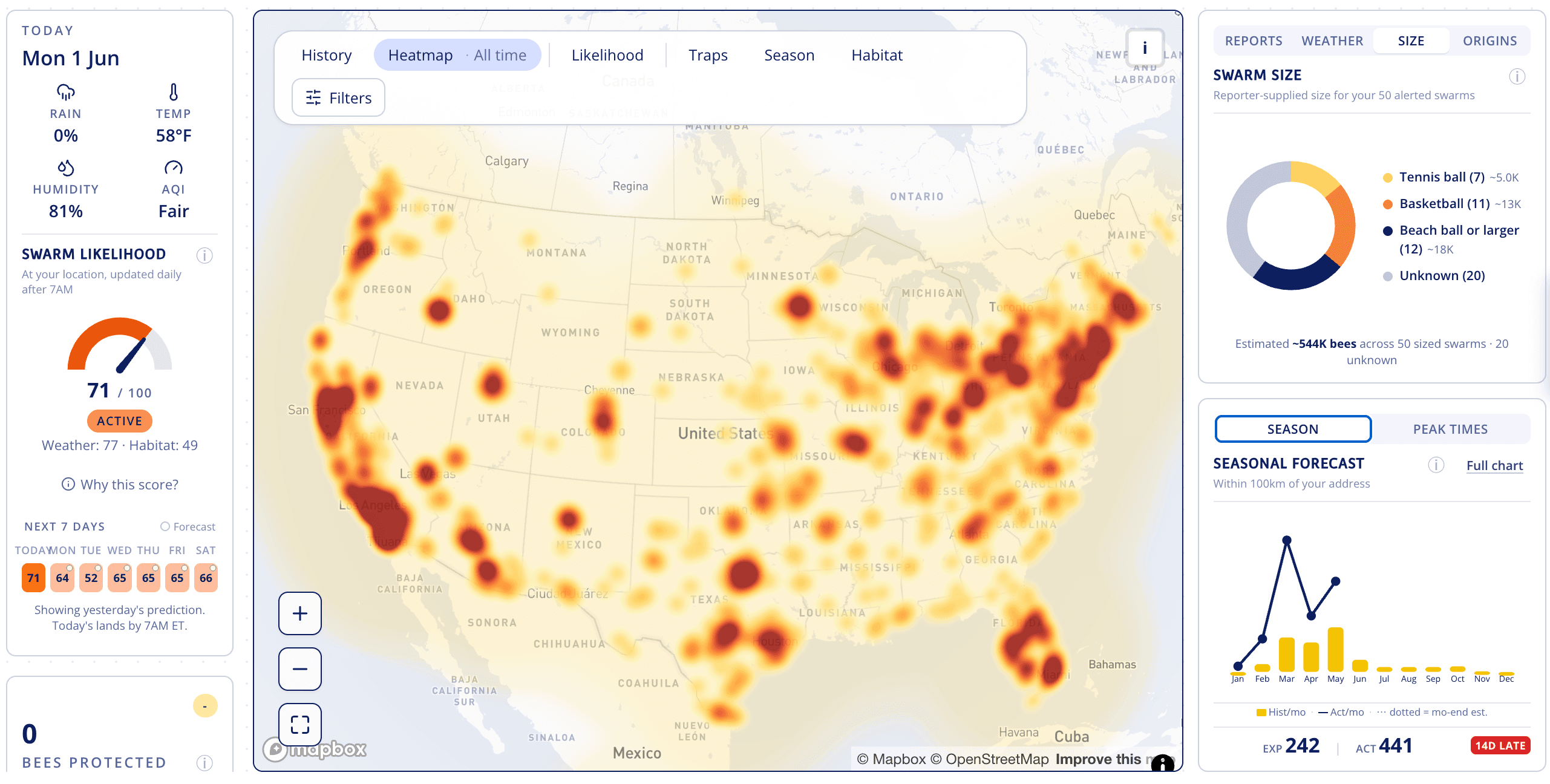
The Contributor dashboard brings every data tool into one view, updated daily.
Honey bee swarms are one of nature's reliable seasonal signals. When a colony splits in spring and the old queen leaves with half the bees to find a new home, the timing, location, and pattern of that event reflect something real, from the health of the colony and the quality of the winter to the temperature of the spring and the density of local beekeeping activity.
For most of beekeeping history this signal existed but couldn't be measured. Individual beekeepers kept notes and local associations tracked calls, but there was no way to see the pattern at scale, across a region or a continent, year over year.
Swarmed was built to change that. Since March 2024 we have collected over 20,000 georeferenced swarm reports, most of them from North America, each one carrying a GPS coordinate, a date, and an outcome. That dataset now underpins a set of analytical tools that are useful to beekeepers planning their season and meaningful to anyone interested in what the bees are telling us about the broader environment.
Honey bee swarms don't appear randomly. They cluster in predictable places, near established colonies, near natural cavities in mature trees, in landscapes that can support them. They follow the season with remarkable fidelity, tracking accumulated warmth rather than calendar dates. And they respond to disruption, whether a warm winter, a drought year, a change in land use, or a disease event in the local bee population.
Each of these signals is visible in the data, and you can see how the 2026 season ran in the North America bee swarm season report.
Most of what people report in September and October isn't a swarm at all. Across 2024 and 2025, three quarters of autumn reports were established colonies living in walls, soffits and roof voids, against a third in April and May. Autumn is mostly the season people notice the colony that moved into their house back in spring.
The geographic pattern is telling too. Once established colonies are set aside, the late-season rise in swarms sits in the South: in 2024 and 2025, swarm reports below about 37°N roughly doubled from August to September, while the band from 37 to 42°N stayed flat. That fits colonies swarming a second time where the autumn forage window runs long enough to support it.
This is what population-level data makes visible that individual observation cannot.
Longer write-ups and datasets: how each analysis was done, what the season is showing, and what the figures can and cannot tell you.
How we score the land a colony can reach from satellite land cover, why nearby colony density is shown as its own signal, and what the score can and cannot tell you.
Read the forage methodologyEvery georeferenced Vespa velutina record in Europe read as a spread history: which countries it reached and when, why record counts follow the observers, and what a hornet reported in spring tells you about the season ahead.
Read the spread analysisLate-summer swarming runs at roughly a third of the spring peak, afterswarms spike in August, and the late season runs strongest across the South.
Read the 2026 outlookWhat beekeepers are paid per pound of honey back to 1987, what queens, nucs, and packages cost, state by state honey economics, and the widening gap between bulk and retail.
See the price dataWhat a hive, a box of frames and a beginner's kit cost, read part number by part number from fourteen years of Dadant, Mann Lake and Brushy Mountain catalogs, with the same year priced by three suppliers independently.
See what equipment costsHow the 2026 season ran: when reports came in, what the late-summer rise was made of, and where it was concentrated.
Read the season reportA century of Statistics Canada honey and colony figures province by province, covering how many beekeepers and colonies there are, how much honey they produce, and what that honey is worth.
See the Canadian dataManaged honey bees are, paradoxically, one of our better windows into ecosystem health precisely because they are so mobile and so sensitive to their environment. A swarm that settles and survives reflects a landscape that can support it, while one that doesn't reflects something about resource availability, pesticide exposure, disease pressure, or the absence of suitable nesting habitat.
The Swarmed dataset captures something most ecological datasets cannot, the actual behavior of a large animal population across a continent, in near real time, at the scale of a neighbourhood. Rather than a survey or a model, it is a direct observational record of where bees went, when, and what happened next.
At current scale, the dataset is most powerful for tracking seasonal timing and geographic patterns at the county and state level. As coverage grows, with more beekeepers, more regions, and more years, it will become progressively more useful for finer-grained analysis, such as which urban landscapes produce the most swarms relative to their managed hive density (suggesting high feral colony survival), which regions are showing earlier seasons than their climate would predict, and where the gap between swarm production and swarm capture is largest (indicating unmet demand or underserved beekeeper communities).
The monitoring infrastructure that makes this possible is the same infrastructure that alerts a beekeeper in Denver that a swarm appeared three blocks from their house this morning, and the scientific value is a deliberate byproduct of that practical utility.
Making this data open is the work of Citizens of the Hive, our citizen science initiative for pollinator research.
We make no claim about whether one year's swarm season came earlier or later than another's. When we tested year-over-year shifts in report timing, they tracked the growth of the reporting network more closely than local spring weather, so a days-earlier figure would describe our growth rather than the bees. Seasonal findings are stated as shares and shapes within a year instead.
Habitat scoring draws on three inputs, historical swarm density per H3 hex cell (approximately 0.74 km² each) from Swarmed's full report database, registered beekeeper density within 3km as a proxy for active colony density, and canopy height data from the Meta/WRI Global Canopy Height Model (Tolan et al., 2024), which identifies areas with mature trees structurally capable of hosting natural bee nesting cavities.
Daily weather data for the likelihood scores is sourced from Open-Meteo.
Full methodology is available at beeswarmed.org/season.
The same data that underpins the analysis above drives the practical tools in the Swarmed dashboard. If you keep bees you can sign up for Contributor access and run them on your own apiary, on a pay-what-you-want basis.
Every swarm ever reported to Swarmed appears as a dot on the map, forming a heatmap of historical density at low zoom that resolves into individual clickable reports up close. Locations where swarms appear repeatedly carry residual pheromone signals from previous colonies and physical traits that make bees want to settle there. Knowing your local hotspots is the single most useful input for swarm trap placement.
Every morning, a swarm likelihood score from 0 to 100 is calculated for every monitored location, drawing on five weather variables and three habitat factors. The weather component uses the same Growing Degree Day methodology as agricultural pest forecasting, tracking accumulated biological readiness rather than calendar dates. The habitat component reflects historical swarm density, proximity to registered beekeeping activity, and mature tree canopy cover from satellite data.
A running comparison of how the current season is tracking against the historical average for your region. If your area is running 50% above expected through April, that tells you something useful about how to deploy your time and equipment for the rest of the spring.
A ranked list of the best places to set swarm traps within your catching radius, combining historical swarm density, distance from your apiary, local beekeeper density, and mature tree canopy cover from satellite imagery. Trap specifications (about 4.5 metres high, 40-litre cavity volume, southeast-facing entrance) are drawn from Thomas Seeley's controlled nest site selection experiments at Cornell University and Appledore Island.
A per-apiary read on the land your colonies can reach, scored from satellite land cover across the H3 hex grid. It shows how good the surrounding forage is, how many colonies are already foraging nearby (shown as a floor, since feral and unregistered hives stay uncounted), and how the current season is tracking against the local norm. The two facts (land quality and nearby competition) are kept separate rather than blended, so good land in a crowded area still reads as good land.
Sign up, tell us where your apiary is, and the dashboard fills with your own local swarm history, today's likelihood score, and the trap sites ranked around you. Contributor access is pay what you want.
Swarmed is a swarm alert service that runs on data. The more swarms the public reports, the more accurate the predictions become. The more accurate the predictions become, the more useful the platform is to beekeepers and communities. And the more comprehensive the dataset becomes, the clearer the picture of what is actually happening to honey bee populations across the world.
Every data point starts with a sighting.
If you are a researcher or institution interested in the dataset or in collaboration, we would like to hear from you at [email protected].
The dataset is strongest in regions with consistent multi-year coverage. Findings from areas with sparse or single-season reporting should be read with that caveat in mind.