The 2026 North American Swarm Season
The season peaked in mid-May, and its autumn rise is mostly colonies already living in buildings
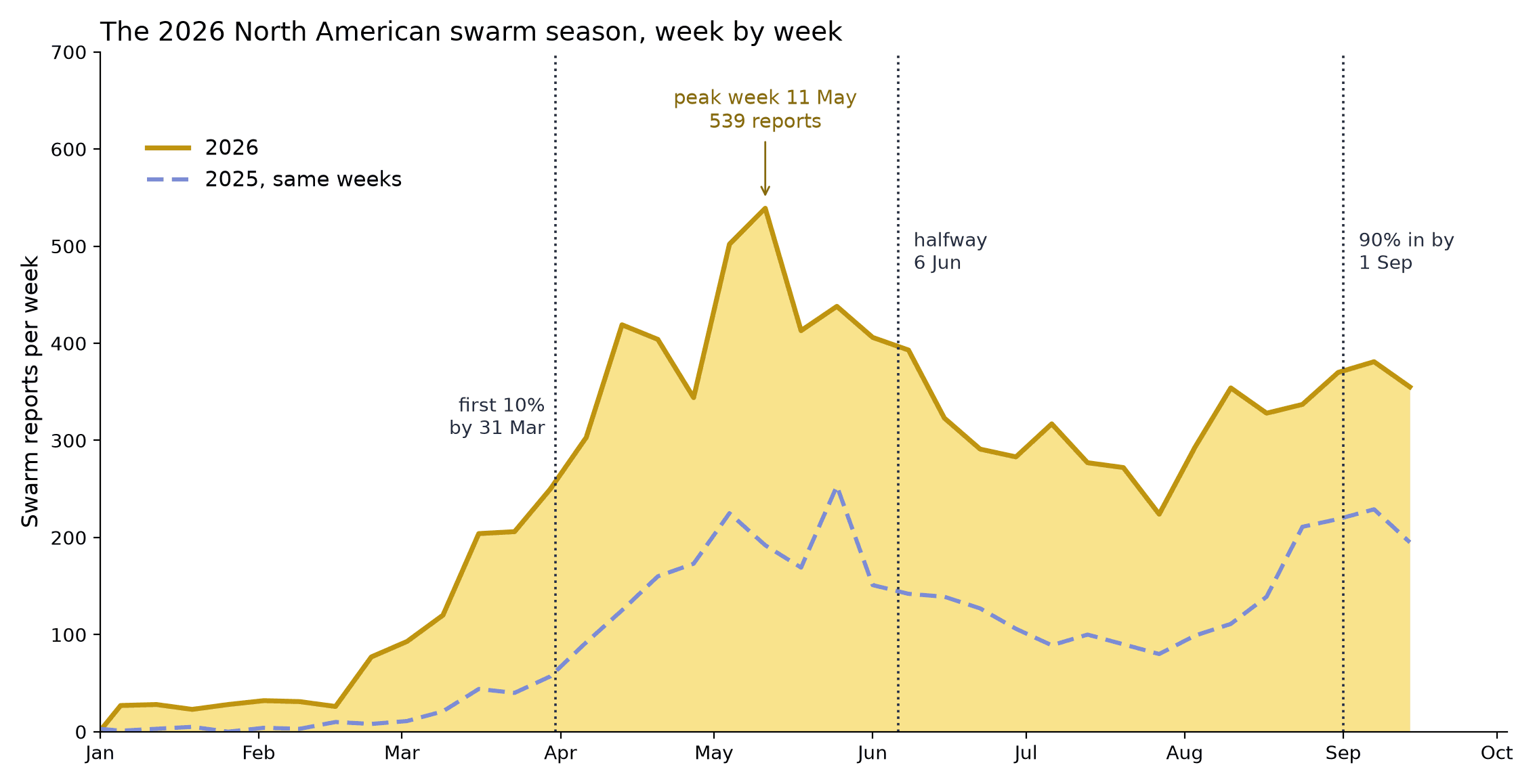
Swarmed's network watched the 2026 North American season build from late March, peak in the week of 11 May and pick up again in late summer. This report sets out the shape of that year: when reports came in, what the late-summer rise was made of, and where it was concentrated.
31 March
The first 10% of the year's reports were in
Counting reports from 1 January to 20 September 2026. Half had arrived by 6 June and 90% by 1 September.
21%
Of the year's reports came in May
The busiest month, with the peak week starting on 11 May. April and June each carried a little over 15%.
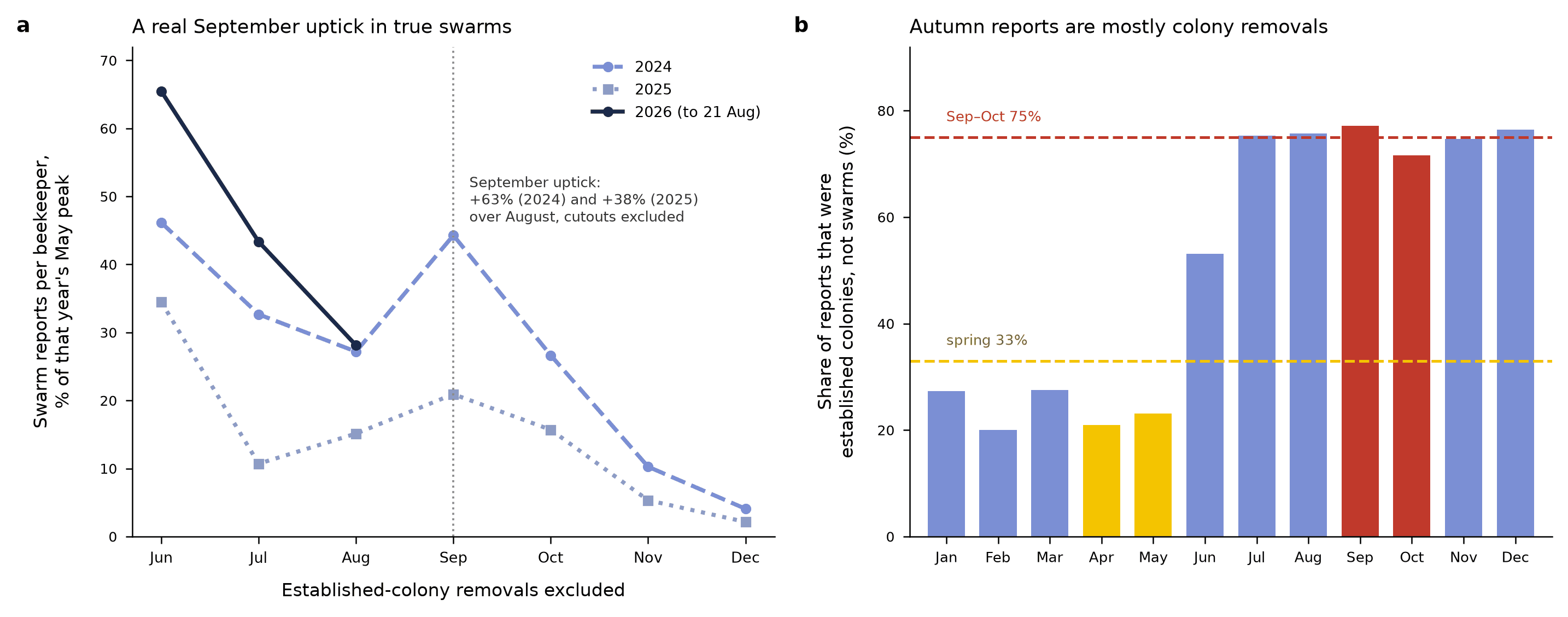
3 in 4
Autumn reports were established colonies
September and October, pooled across 2024 and 2025, against a third in April and May. Most of the autumn rise is colonies in buildings, not swarms.
Published by beeswarmed.org · 21 August 2026 · Based on Swarmed's North American swarm report record, collected since March 2024
If you have found a swarm while reading this, you can report it free of charge and we will alert the beekeepers registered near you, usually within minutes. Everything below is a record of how the season ran.
Two record years of colony loss
“The 2024-25 Apiary Inspectors of America survey showed beekeepers lost 55.6% of their colonies over winter, the highest loss rate since the annual survey began in 2010. So this spring beekeepers are extremely eager to catch swarms to replenish their hives with strong local bees.”
Swarm Season
How the season actually ran
Share of 2026's North American reports, by month
- Jan1.1%
- Feb1.6%
- Mar7.3%
- Apr15.4%
- May21%
- Jun15.7%
- Jul12.6%
- Aug14.7%
- Sep10.7% (partial)
Shares of reports from 1 January to 20 September 2026; September was still in progress.
The season has a second, smaller act
“By running a national swarm reporting network we're able to get more swarms to beekeepers, but we're also building up data on seasonal patterns that we couldn't see before, and share those with beekeepers and researchers.”
What Swarmed does
Live reports, right now
Swarm tracker
This page is the closed-season summary. The tracker behind it runs all year: every swarm reported to Swarmed carries a GPS coordinate, a date and an outcome, and the North American record runs from March 2024, which is three seasons. Report totals are deliberately absent from the findings above, because they track how fast the reporting network grew rather than how many swarms occurred. For the same reason, treat the live counts below as activity on the network, not as a census of bees.
- Live reports : swarms as they are reported, across the whole network.
- Swarm lists by state : season totals, how many went unclaimed, and peak timing for each state we publish.
- Report a swarm : adds to the record and routes it to nearby beekeepers.
Among the counties with at least 10 swarm reports in both 2025 and 2026, these have their own local swarm pages: Ventura, Riverside, San Diego, Contra Costa, Los Angeles, Santa Clara, San Mateo and San Bernardino in California, Maricopa in Arizona, Clark in Nevada, and Broward, Miami-Dade and Palm Beach in Florida.
Methodology & Data Sources
Scope.Everything on this page covers North America, taken as latitude 15 to 72°N and longitude 170 to 50°W, so the roughly 11% of 2026's reports that came from Swarmed's European and Australian operations are excluded from every figure here, as are test entries, deleted records and reports identified as wasps rather than honey bees. Established-colony removals, which beekeepers call cutouts, are counted throughout except in the late-season section, where the caption says they are not.
No year-over-year timing claims.This report makes no claim about whether the 2026 season came earlier or later than 2025's. When we tested year-over-year shifts in report timing, they tracked the growth of the reporting network more closely than local spring weather: raw counts peaked two weeks earlier in 2026 than in 2025 while Swarmed's registered-user base grew from 1,917 to more than 12,000, and expressing volume per registered beekeeper makes that shift disappear and weakly reverse. Earlier versions of this page led with season-start shifts in days; they have been withdrawn, and for the same reason report totals appear nowhere in the findings above.
The dataset
Every report in Swarmed's own network carries a GPS coordinate, a date and an outcome, and the North American record runs from March 2024, which gives three seasons of tracking in 2024, 2025 and 2026, with archival iNaturalist records reaching back to 1967 extending the historical baseline. Report totals appear nowhere in the findings above, since they measure how quickly the reporting network grew rather than how many swarms occurred.
The 2025 reference curve
2025 appears here as a reference curve in the weekly chart and in the late-season comparison, and it had an odd autumn, with October to December report volume running 18 to 29 times its 2024 level while registered-user growth had already fallen back to roughly 1×, a pattern that belongs to a one-time outreach push rather than to bee activity, and one that had decayed back to 0.95× by July 2026. The weekly chart shows 2025 over matching weeks only.
The weather model
Swarmed scores daily weather conditions for each monitored region using five variables: accumulated growing degree days since 1 January, a standard measure of accumulated warmth above 10°C used in agricultural forecasting to track biological readiness in insects and plants; maximum daily temperature; peak solar radiation; the number of warm days in the preceding week; and whether rain occurred.
Surge events
When a colony has been confined by rain or cold for three or more consecutive days, swarming pressure accumulates. The first suitable flying day after such a period produces a spike in swarm activity. Swarmed detects these events automatically and sends alerts to beekeepers in affected regions. Surge conditions require daily solar radiation above 25 MJ/m², maximum temperature above 20°C, and no rain on the release day. About 18% of region-days in the weather record clear that radiation bar.
Habitat factors
Two locations with identical weather can still differ in swarm activity, so each is also scored on historical swarm density at the site and on proximity to active registered beehives within 3km. Mature tree canopy cover, taken from the Meta/WRI Global Canopy Height Model (Tolan et al., 2024), sits alongside those as a third factor and remains unvalidated, its apparent predictive power disappearing as soon as you restrict the comparison to locations that actually carry a measured value, which suggests coverage rather than canopy was doing the work. It is named here because it is in the model, not because we lean on it.
Trap placement
Swarm trap recommendations follow the nest site preferences established by Thomas Seeley's controlled experiments at Cornell and Appledore Island (summarised in Honeybee Democracy, Princeton University Press, 2010): 40-litre cavity volume, entrances of 12.5–75 cm², mounted about 4.5 metres up, southeast-facing orientation. The same figures drive the trap recommendations in the Swarmed dashboard.
Key references
- Henneken, R., Helm, S., & Menzel, A. (2012). Meteorological influences on swarm emergence in honey bees (Hymenoptera: Apidae) as detected by crowdsourcing. Environmental Entomology, 41(6), 1462–1465. doi:10.1603/en12139
- Rutschmann, B., Kohl, P. L., & Steffan-Dewenter, I. (2025). Swarming rate and timing of unmanaged honeybee colonies (Apis mellifera carnica) in a forest environment. Insectes Sociaux, 72(4), 505–512. doi:10.1007/s00040-025-01028-y
- Tolan, J., et al. (2024). Very high resolution canopy height maps from RGB imagery using self-supervised vision transformer and convolutional decoder trained on aerial lidar. Remote Sensing of Environment, 300, 113888. doi:10.1016/j.rse.2023.113888
- Seeley, T. D. (2010). Honeybee Democracy. Princeton University Press.
- US Beekeeping Survey, 2024–25 and 2025–26. Apiary Inspectors of America / Auburn University / Oregon State University. 2025–26 results published 24 June 2026.
Data limitations
The 2024 season carries too few North American reports to serve as a comparison year, and 2025's late autumn is distorted by a one-time outreach push, which is one more reason this page makes no year-over-year timing claim. Late-season figures for 2026 stop at the 21 August cutoff. The week-by-week chart and the monthly shares were refreshed on 27 September 2026 and run to 20 September.
When is swarm season in Canada?
Later than in the United States, and by enough to matter. American swarm reports peak between April and June. Canadian swarm reports peak in July, with a season that runs from the second half of May into September and is still producing in August when most American beekeepers have finished. A Canadian beekeeper working from American swarm-season advice will set bait hives roughly six to eight weeks early.
The figures above are continental and weighted toward the United States, where almost all of our reports come from, so read them as the North American picture rather than the Canadian one. Our Canadian base is thin: 91 reports as of 2026-08-26. It is enough to date the peak and not enough to date a province, which is why there is no provincial breakdown here.
Province by province, including what each one requires of a registered beekeeper, is on beekeeping in Canada, with the two provinces we have real coverage in at Ontario and British Columbia.